Global media Update tech Update & Automobile Life Style & Entertainment

Patnaites............. the people of Patna
Patnaites............. the people of Patna

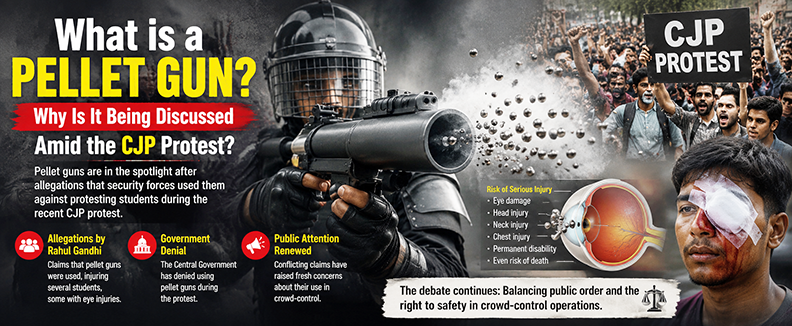
New Delhi: Pellet guns have come under the spotlight following allegations surrounding the recent CJP protest. Leader of the Opposition Rahul Gandhi alleged that security forces used pellet guns against protesting students, claiming several youths were injured and some suffered eye injuries. The Central Government has denied these allegations, stating that pellet guns were not used during the protest. The conflicting claims have renewed public attention on the weapon and its use in crowd-control operations.
A pellet gun is a less-lethal weapon primarily used by police and security forces to disperse violent crowds during riots or public disturbances. Similar technology is also used in hunting and pest control. While pellet guns are considered less lethal than conventional firearms, they are not risk-free and can cause serious injuries.

A pellet gun cartridge contains hundreds of tiny metallic pellets, traditionally made of lead or other metals. When fired, these pellets spread over a wide area, enabling a single shot to strike multiple individuals. This wide dispersion makes pellet guns effective for crowd-control situations but also increases the risk of unintended injuries.
Experts caution that although pellet guns are categorised as less-lethal weapons, they can still cause severe harm. Pellets striking sensitive areas such as the eyes, head, neck or chest may result in permanent vision loss, serious trauma or, in rare cases, death. The risk increases significantly if the weapon is fired from close range.
The use of pellet guns has been a subject of debate, particularly after previous protests in which protesters reportedly suffered severe facial and eye injuries. Human rights organisations have argued that pellet guns have caused permanent vision impairment in numerous cases and have questioned their use in civilian crowd-control.
Security agencies, however, maintain that pellet guns are intended as a less-lethal alternative to conventional firearms and are deployed under strict operational guidelines when other methods fail to control violent situations.
Pellet guns and their ammunition have traditionally been manufactured by India’s government-owned ordnance production units. Over time, authorities have introduced modified types of pellets that are considered less likely to cause fatal injuries compared with earlier designs, although experts note that the risk of serious harm remains.
The latest debate follows allegations by Rahul Gandhi that pellet guns were used during the CJP protest, injuring several students and causing eye injuries. The Central Government has rejected these claims, saying no pellet guns were deployed. As of now, there has been no official confirmation publicly establishing whether pellet guns were used during the incident.
The controversy has once again raised broader questions about the balance between maintaining public order and minimising the risk of injury during crowd-control operations.

Auto Amazon Links: No products found.