Global media Update tech Update & Automobile Life Style & Entertainment

Patnaites............. the people of Patna
Patnaites............. the people of Patna

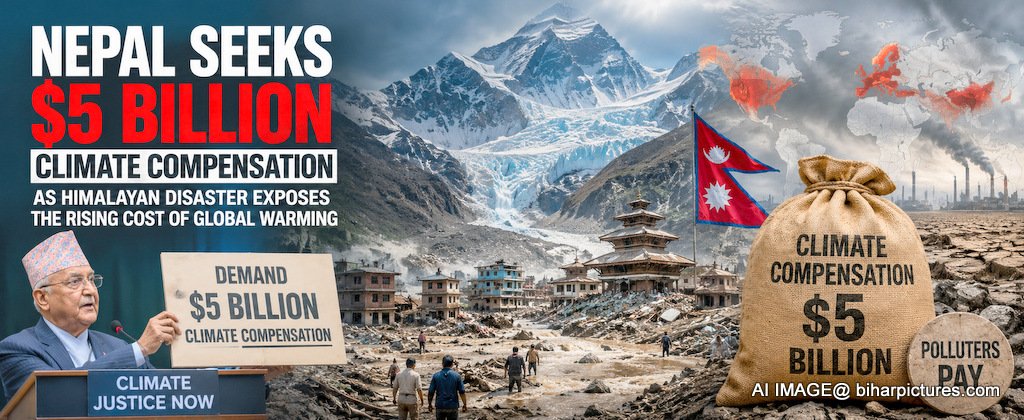
Kathmandu: Nepal has intensified its call for climate justice after a devastating flood disaster along the Nepal-Tibet border left more than 1,000 people dead and thousands missing, arguing that countries contributing most to global greenhouse gas emissions must bear a greater share of the financial burden of climate-related destruction.
The Himalayan nation has assessed losses at around $5 billion and is seeking immediate financial assistance through the United Nations’ proposed Climate-Disaster Recovery Fund to support rescue operations, recovery and long-term reconstruction. But beyond emergency aid, Kathmandu is pushing for a fundamental change in the way the international community responds to climate disasters in vulnerable countries.

Nepal’s position is that the crisis cannot be addressed simply through humanitarian donations. It is demanding what it describes as climate compensation, based on the principle that countries responsible for a disproportionate share of historical and current emissions should contribute to the recovery of nations facing severe climate impacts despite having made only a minimal contribution to global warming.
The disaster has brought the vulnerability of the Himalayan region into sharp focus. According to the figures cited by Nepal, 987 people have died in Nepal and another 16 in Tibet, China, taking the combined death toll to 1,003, while nearly 4,000 people remain missing.
For a country located at the frontline of climate change, the scale of destruction has reinforced concerns that traditional disaster-response mechanisms are no longer sufficient to deal with increasingly extreme events.
Nepal’s Foreign Minister Shishir Khanal, speaking to The Kathmandu Post, described the disaster in stark terms and argued that the country is paying an exceptionally high price for a climate crisis it did little to create.
According to Khanal, the waves that struck the Bhotekoshi and Trishuli river systems on August 26 were between 20 and 30 metres high, while the flow of water reportedly reached speeds of up to 180 kilometres per hour.
Such forces, he said, went far beyond what could ordinarily be described as a conventional flood.
The scale of the destruction has led Nepal to describe the event as a “Himalayan tsunami”, underscoring the growing concern that the combination of melting glaciers, unstable mountain terrain, intense rainfall and rapidly changing weather patterns could produce disasters of unprecedented magnitude.
The consequences extend beyond Nepal’s borders. Himalayan rivers are critical sources of water for millions of people across South Asia, and changes in the region’s glaciers and river systems could have profound implications for agriculture, drinking water, energy production and ecosystems.
Nepal’s diplomatic response represents a significant shift in emphasis. Rather than relying solely on international humanitarian assistance after a disaster, Kathmandu is seeking to place climate responsibility and compensation at the centre of international negotiations.
Maheshwar Dhakal, described as Nepal’s climate change chief, said vulnerable countries are suffering consequences far beyond what their contribution to global emissions would suggest.
The argument is central to the broader global climate-justice debate. Developing and climate-vulnerable nations have repeatedly pointed out that their historical contribution to greenhouse gas emissions is relatively small, while the economic and social consequences of climate change are increasingly being borne by them.
Nepal’s financial ministry has reportedly issued a “climate compensation claim letter” to international partners, signalling that Kathmandu intends to pursue the issue through diplomatic and financial channels.
Khanal has stressed that Nepal is not asking for charity or a handout. Rather, he has framed the demand as a matter of legal and moral responsibility.
In his assessment, the world’s largest industrial and emitting economies have a responsibility to help countries that are suffering disproportionate consequences from a crisis they did not substantially cause. He specifically pointed to China, the United States and India as the three largest emitters and argued that their historical responsibility should be reflected in support for highly vulnerable countries such as Nepal.
The disaster also highlights a much larger environmental concern: the rapidly changing Himalayan climate.
The Himalayas contain some of the world’s most important mountain glaciers and are often referred to as the “water towers” of Asia. Rivers originating in the region sustain communities and economies across several countries.
But rising temperatures are altering the delicate balance of the mountain environment. Glacier retreat, the expansion of glacial lakes, unstable slopes and extreme precipitation events can increase the risk of sudden floods and landslides.
Khanal has warned that if Himalayan glaciers continue to melt at an accelerating rate, the consequences could reach far beyond Nepal. More than two billion people in South Asia depend directly or indirectly on river systems originating in the Himalayan region.
The threat is therefore not limited to individual disasters. It could gradually undermine water security, food production and livelihoods across one of the world’s most densely populated regions.
Nepal’s demand also raises an important question about the adequacy of existing climate-finance mechanisms.
For vulnerable countries, the cost of adapting to climate change is already enormous. Building flood-resistant infrastructure, relocating communities from high-risk areas, protecting roads and bridges, strengthening early-warning systems and restoring damaged ecosystems require sustained investment.
When an extreme event destroys infrastructure and livelihoods within hours, however, adaptation investments alone cannot prevent economic losses.
This is where the debate over loss and damage becomes crucial. Climate-vulnerable nations have argued that compensation mechanisms are necessary for irreversible losses that cannot be prevented through adaptation.
Nepal’s $5 billion assessment illustrates the scale of the financial challenge. Reconstruction following a major Himalayan disaster can involve not only roads, bridges, homes and public buildings, but also agricultural land, tourism infrastructure, hydropower facilities and entire communities whose livelihoods depend on mountain ecosystems.
For Nepal, therefore, the demand for climate compensation is as much about future resilience as it is about recovering from the present disaster.
The latest catastrophe should be viewed as a warning for the entire region.
Nepal, Tibet, India, Bangladesh and other parts of South Asia are connected through shared river systems and climatic processes. A disaster originating in the mountains can rapidly affect downstream populations through floods, sediment flows and disruptions to water and transport networks.
Climate change is making these connections increasingly important.
The Himalayan disaster demonstrates that environmental crises do not respect national borders. The emissions produced in one part of the world can contribute to warming elsewhere, while the impacts can fall most heavily on communities with limited resources to respond.
Nepal’s new diplomatic stance therefore carries significance beyond its own borders. By demanding compensation rather than simply requesting emergency assistance, Kathmandu is seeking to turn a devastating disaster into a broader conversation about climate responsibility, equity and global accountability.
The tragedy has exposed a difficult reality: for countries on the frontline of climate change, the question is no longer whether global warming will cause damage, but who will pay for the damage already occurring and the increasingly severe risks ahead.
As Nepal begins the enormous task of rescue, recovery and reconstruction, its $5 billion demand is likely to add fresh pressure to international climate negotiations. The Himalayan nation is effectively asking the world to recognise that climate disasters are not merely natural catastrophes. They are also a consequence of an unequal global emissions history—and, increasingly, a test of whether the international community is prepared to match climate promises with financial responsibility.

Auto Amazon Links: No products found.